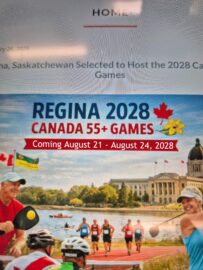
Welcome to our site. We hope that you will find the information you need to pique your interest, your fitness and enable you to take part in the Canada Senior Games.
Looking for sample job descriptions for a Team Manager/Chef de Mission? Click here.
Photos from Portage la Prairie Canada Senior Games. Many, many more to come so please check back often. For complete Games results go to: http://www.canadaseniorgames.ca/results.htm
The 2006 Canada Senior Games are now history and we are already looking forward to the 2008 Games in Dieppe, New Brunswick, August 26 (registration day) to 31 (departure day), 2008. The 2006 Games were the largest ever and extremely successful from all accounts.
If you have photographs from Portage la Prairie please send them to us electronically or in hard copy (c/o Gary Black 5004 57 St. Yellowknife NT X1A 1Y5) and we will post them on the site with full credit to you.
Stay tuned for information on the Dieppe Games as plans develop. TENTATIVE ACTIVITIES: Swimming, track and field, golf, tennis, cribbage, horseshoes, candlepin bowling, bridge, slo-pitch, lawn bowling, floor shuffleboard, darts, ice curling, scrabble (French and English), table tennis, whist, badminton.
Minutes of 2005 Annual General Meeting
Minutes of 2004 Annual General Meeting
A few photographs from Portage la Prairie.
Minutes of 2003 Annual General Meeting.
What are the "Canada 55+ Games"?
The Canada 55+ Games is a nation-wide program to sponsor wellness – that is, the spiritual, mental and physical well being – among Canadians 55 years of age and older. Provincial programs are staged annually in different provinces and territories. The first national Games were held in Regina in 1996. The Games should not be categorized as sporting events, as they span a wide range of physical and mental challenges, from Slow-pitch Softball to Contract Bridge, from Darts to Lawn Bowling, and from Snooker to Track and Field . These events bring together amateur competitors who participate for the sheer joy of competition, for the opportunity to visit other parts of Canada, and for the camaraderie and social interaction that are an integral and essential part of the Games.
The Games bring together relatively small groups, representing their respective provinces or territories. These groups earn the right as a result of competition against thousands of other seniors in their home province or territory. The 700 or so who compete in the Games represent over 100,000 Canadian seniors who actively participate in local events leading up to the national games.
MISSION
Through both
active and passive games our mission is to influence personal behavior and
social supports that encourage healthy, active living for older adults in
Canada.
GOAL
Our goal is to produce a lasting influence on the knowledge, attitudes and behavior of older adults in Canada.
PURPOSE
To provide
older adults with an opportunity to:
ź
increase their social interaction
with others
ź
increase their physical and mental
well-being
ź
maintain and
enhance their psychological and mental well-being through participation in
recreational, cultural and sports.
OBJECTIVES
ź
To promote improved
fitness.
ź
To encourage increased
participation on an on-going basis.
ź
To promote a positive, active
image of older adults.
ź
To promote activities that
reflect current needs of the older adult in relation to their mental
well-being.
ź
To enhance the opportunity for
older adults to expand and develop their social interaction.
ź
To facilitate more
co-operation and communication between older adult groups.
ź To establish an environment that reflects current trends in sport, fitness, cultural and artistic activities.
VISION
The vision of the Canada 55+ Games is to promote participation by all seniors in an active and enjoyable lifestyle. Thus, the Games are a means to an end - the promotion of activities for all seniors. All the fun, friendship and festivity will be bonuses.
Why Should We Invest in Wellness?
Canada’s population is aging. We are not unique – the industrialized nations of the world are challenged with a senior population that is growing, chiefly attributable to both the ageing of the WWII baby boomers and the significant advances of medical procedures and technology. The following chart, based on recent Statistics Canada data, illustrates the growing number of Canadian seniors. In 1920, seniors 65 and over represented just under 5% of the total population. Today, that number has reached 12.5%, or approximately 3.8 million seniors. It is projected that by 2040 seniors will represent a quarter of the population. The University of Ottawa’s Canadian Study of Health and Ageing speculates that there will be about 7.8 million Canadians 65 or over by 2031.
The National Advisory Council on Aging adds that in addition to the 3.8 million seniors of today, there are another 2.5 million "near-seniors", 55 and over.
These are real statistics that present significant challenges to Canada, not the least of which is the ever rising cost of health care for seniors. There are many ways to meet these challenges, and investing in wellness is but one. By improving the mental and physical well being of seniors the costs of health care will be mitigated and Canada’s seniors will continue to lead even more useful lives, contributing even more significantly to the overall prosperity of Canadians.
The life styles of Canada’s seniors are also changing. In the past, seniors worked to the magic age of 65 when they retired to sedentary lives. They were expected to stand aside, out of the way of the hustle of everyday life and to put miles on the rocking chair. Such a lifestyle encouraged all sorts of physical, emotional and social problems. The daily contact with co-workers and the sense of purpose connected with a career provided a feeling of pride and self-worth which, coupled with a regular, daily routine, established a framework for living. For many, this framework ended dramatically at 65.
Times have changed. Spurred on by downsizing and early retirement, the definition of "senior" has been revised. The corporate world increasingly sees the benefits of seniors, and are looking to those 55 and over, and in some case as young as 50. They recognize the value of older adults – in real dollars. Insurance companies, money management companies, banks and financial institutions are spending millions to capture the attention, and the spending power, of this important segment of our population. The "Freedom 55" advertising campaign has become more than a dream for many Canadians. With more people leaving the workforce and leaving at an earlier age than in the past, the available leisure hours are also increasing. The challenge is to channel this leisure time into more productive time and thereby minimizing the ever-present threat of what has come to be known as "Senior Social Isolate".

|
The Benefits of Participating in Regular Physical Activity and Maintaining an Active Lifestyle: | |
|
The Social & Psychological Facts |
The Physical Facts |
|
A physically and mentally active lifestyle helps seniors to cope with stress and anxiety. Older adults who are active are more self-confident, more independent and enjoy life more than those who are sedentary. Physical and mental activity reduce the likelihood of development of psychosomatic diseases. Research indicates that most older adults have the ability to participate in some type of activity, and that these activities can improve the quality of life. Older adults who are active have more opportunities for socialization and friendship than those who are inactive. Socially active seniors make a positive contribution to the community. It is therefore important to provide opportunities for participation in activities such as those at the Canada Senior Games and all the various levels leading up to these Games. |
Active living is particularly important for seniors. In general, physical activity improves the overall health, appearance, and mobility of older adults. Fit seniors live longer, remain in their own homes longer, participate more fully in community life and decrease their reliance on health care and social services. Recent studies have proven that older adults who regularly participate in physical activities substantially reduce their risks of suffering from coronary heart disease, diabetes hypertension, and osteoporosis. Physical activity improves blood circulation and digestion, and also improves strength, flexibility and balance. It is important for older adults to realize that it is never too late to begin to exercise regularly to improve cardiovascular endurance, lower blood pressure and increase bone mineral content. |
Organizing the Canada 55+ Games
Many provinces have organized associations for seniors that have been in operation for years. For example, the Saskatchewan Senior Fitness Association was formed in 1984 as a voluntary, non-profit charitable association. It was set up to promote and encourage an active, healthy lifestyle for seniors, and has done so by putting on fitness workshops for seniors in different centres of the province, and organizing a Senior Games event on a biennial basis.
The CSGA has provincial association members in all but three provinces: Quebec, Nova Scotia and Newfoundland, and in the new territory of Nunavut. Through the provincial associations, the CSGA has just over 1000,000 members. The provinces that do not have provincial associations do have a number of separate seniors' groups, often organized around a particular activity, such as curling. These groups can and do participate in the Canada Senior Games. Efforts are ongoing to organize these disparate groups into provincial associations and have them represented nationally by the CSGA.
The games also offer participants ample opportunity for social interaction. This could include coffee houses, banquets, dances, open and closing ceremonies featuring local talent, and more.
Although by the very nature of games the goal is to declare a winner or winners, the aspect of wining is de-emphasized. Rather, the coming together for the games is more important.
The next Canada 55+ Games will be held in Dieppe, New Brunswick August 26- August 31, 2008
Still have more questions? Click here to send an e-mail message.
Please send us an e-mail with comments or suggestions for the web site.